What Percentage Should Labour Cost Be in a Restaurant?
Working at a restaurant is a right of passage for many young people, and those who stay in the industry can have promising careers. From entry-level servers to five-star chefs, there are many opportunities for workers. But how much can you pay employees without jeopardising your business?
Labour is often one of the highest expenses for a business. For a typical restaurant, labour costs will make up about 30% of revenue. That said, this figure can vary depending on the type of restaurant.
Here are some typical labour costs percentages according to BDO:
Let’s look more at finding your labour cost and calculating the labour cost percentage.
How to find your labour costs
Since restaurant profit margins can be quite low, you will want to track your financial picture carefully to reduce wasted spending. Since many expenses are fixed and unable to change, you want to optimise those that are in your control.
Labour costs include wages, but many other expenses fall under this term. To see your labour cost, you want to add up the following items:
- Salaried employee wages
- Hourly employee wages
- Overtime
- Incentives and bonuses
- Payroll taxes
- Health insurance
- Paid days off
To get your actual labour cost, you add these up over a designated period, such a weekly, monthly, or annually. That final figure is your labour cost.
Calculating your labour cost percentage
Once you have this number, you will need to divide it by a larger figure to see your labour cost percentage. Most often, this larger number is your revenue or operating costs.
Labour cost divided by revenue
This is the most common way to measure labour cost percentage. Since your revenue will cover your labour costs, you need to make sure you have a healthy labour to revenue ratio. Funds need to be left over to cover other expenses like rent and marketing.
If you wanted to track your monthly labour costs, you would first add up all costs as outlined above. Next, you will want to add up all sales before deducting any expenses. This gives you your monthly revenue. Once you have both, you divide labour costs by revenue to see your percentage.
Here's the formula you need:
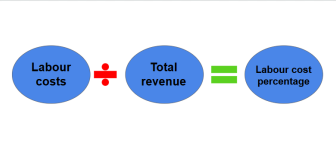
Example: $4000 ÷ $15,000 = .2667 or 26.67%
Labour costs divided by operating costs
As we stated earlier, some expenses are fixed and others can change. By viewing your labour costs as a percentage of overall costs, you can analyse your spending to see where to focus your cost-saving efforts.
First, find your total labour costs as outlined above. Next, add up all your expenses. Be sure to include rent, utilities, marketing, software subscriptions, food costs, uniforms, and all other expenses. Lastly, you will divide your labour by your total expenses.
Here's the formula you need:
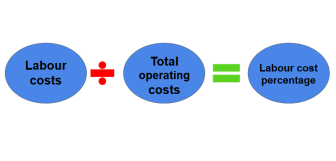
Example: $4000 ÷ $12,000 = .33 or 33%
You can use this formula for other variable costs too, such as electricity and restaurant equipment. That way, you can find a healthy percentage for each expense.
Labour cost calculator
Now you know the formula to use, use a calculator like this one (or the one on your mobile phone) to start summing up your labour cost percentage.
Understanding prime cost
Having access to a variety of key financial figures and statistics can make it much easier to assess the overall financial health of your restaurant. Depending on which figure you look at, you may see a different picture, which tells you which areas of your business may need work.
Your payroll and labour expense is a valuable part of this, but there’s another figure worth tracking that tells you the total figure of running the business in a basic sense. This is prime cost. Prime cost represents the total amount you spend on labour cost + cost of goods sold (COGS). COGS refers to the direct cost of ingredients, beverages, and other consumables used to prepare and serve your menu items. Because these two categories make up the bulk of a restaurant’s controllable spending, understanding your prime cost gives you a clear picture of how efficiently your operation is running. Plus, if you don’t like what you see in your prime cost, it can be easier to do something about it!
Here’s the simple formula:
Prime Cost = Labour Cost + COGS
Depending on your position and customer base in the restaurant industry, you may have a different target for prime cost, but 60% of total revenue is a good target to set your business. This leave you a good margin to cover fixed expenses, like rent, utilities, insurance, equipment and maintenance costs, while still leaving you space to actually make some money!
Labour costs are naturally a key part of controlling your prime cost because it’s controllable. With proper scheduling and training (don’t forget to cross-train your team) and reduced turnover, you can maintain an optimal labour cost while ensuring your team provide a fantastic service and your revenue stays high. You also want to ensure your restaurant wages are balanced against the COGS, as food prices often fluctuate. In times when food costs more, you may need to temporarily reduce labour hours to maintain a balanced prime cost percentage.
Keeping an eye on prime cost ensures you’re not looking at labour or food spending in isolation. Instead, you’re understanding how each component impacts your overall profitability. By managing both sides of the equation, you can maintain healthier margins, reinvest in growth, and build a more resilient business!
How to reduce your labour costs
If your labour costs are too high, you will want to reign them in before they cripple your restaurant. And even if your costs are at a healthy level, reducing them can help you boost advertising spend or invest in new equipment.
Group your workers
Your employees perform different tasks that match their job title, and as such, they earn different hourly wages. By breaking down employees into similar groups, you can see how much each group costs you.
For example, you will know on average what your kitchen staff cost per 8-hour shift vs. your hosts and servers.
Once it comes time to cut costs, you can see which groups cost you the most. While no one likes letting workers go, this process will help you determine which cuts will be most effective.
Cross-train
A normal restaurant likely has a few servers and a host out front and a small meal preparation team in the back of the house. A manager will oversee operations, handle customer service issues, and be the go-to person for all other issues.
On a busy night, this team may only cost 20% compared to your revenue. On a slow morning, however, a full shift like this may cost nearly 50% of your revenue.
By cross-training your team, you can reduce the number of employees on a shift without losing productivity. For example, assigning a hostess the manager’s duties on slow days will reduce your labour costs tremendously. Even paying this person a few dollars more per hour during these situations will cost less than scheduling a manager for an entire shift.
Likewise, you can train hosts to serve food. If a server doesn’t show up to work or needs to go home, your host can keep you operational. The manager can then take over the host’s duties, preventing you from needing to call in any more employees.
Split shifts as a cost-saving tactic
The restaurant business can be unpredictable, and sometimes you schedule a full shift only for the day to be quiet. One way to compensate for that is splitting shifts.
A split shift involves a work-day in two parts with a long break in the middle. Split shifts are great for the restaurant industry, which is naturally busy around mealtimes with afternoons often much quieter as people have already eaten. So, when things start to die down, having some of your staff split their shift and come back for the evening rush means you make full use of them and avoid paying for idle time.
This approach is especially useful for restaurants located in business districts or high-traffic areas with sharp peaks and valleys in customer flow. By building staffing around these fluctuations, you maintain service quality where it matters most.
Of course, split shifts need to be used carefully. Employees need to plan their day to incorporate along break, and those who live further away or do not have their own transport may be firmly against splitting their shifts. For this reason, you may want to offer small incentives or work split shifts into predictable patterns so staff don’t feel inconvenienced. Some restaurants even rotate split shifts evenly across the team to ensure fairness.
When used strategically, split shifts can shrink your labour cost percentage significantly. You’re ultimately aligning labour hours more closely with revenue-generating periods, preventing wasted payroll while still ensuring your dining room and kitchen are properly staffed when guests need you most.
Incentivise performance and attendance
Callouts and no-shows can impact your operating costs. When an employee doesn’t show up, you need to call in another worker to take their place. Not only does this waste a manager’s time, but it also frustrates employees.
While you can fire employees for failing to show up, this doesn’t necessarily discourage the behaviour. Rather, you want to incentivise workers to show up and reward positive behaviour.
For example, you can give workers a £50 bonus for showing up to each shift on time within a set pay period.
Likewise, you can set qualifications to earn a raise. By setting attainable targets, you improve efficiency and reward employees for hard work.
Reduce turnover
Similar to the point above, employees like to feel valued. If your workers do not feel their work is commensurate with their pay, they will seek new jobs. Or if they feel uneasy or discouraged at work, they will look for another restaurant.
Interviewing and onboarding employees is expensive, especially if it involves background checks, uniforms, and government-mandated permits. Reducing your turnover will drastically cut operating costs.
Making your workers feel valued and part of a team can help lessen turnover. Rewarding and recognising workers is one of the best ways to show your appreciation.
No matter how small an action might be, make sure you praise the worker when they act beyond their job description. Even if someone simply organised the supply closet or swept up floors without asking, make sure you recognise their effort.
Of course, these techniques won’t work if you do not pay market wages. After all, your employees are there to earn money at the end of the day.
Track labour daily, not just monthly
It's very common for restaurant owners, and all business owners, to review labour costs at the end of the month. But by the end of the month it's already too late to correct overspending. Daily labour tracking offers insight into how your staffing levels match against actual sales. Monitoring labour-to-revenue on a shift-by-shift makes it easy to spot trends and correct them before they have an impact on your overall prime cost percentage, whether that's understaffing or overstaffing, at lunch, dinner, or in-between.
Daily tracking is something business managers can build into their routine. The review can happen before shifts or at cash-up after close. With POS systems tracking both staff and sales in real-time, this doesn't have to be a long or arduous process. You simply need to look at a report and see if you're on, above, or below your labour target and address any imbalance over the following days. This could mean letting staff go early, or asking people to stay on or come in if your team are a little short and the day is proving busy.
Predictive scheduling based on data
Predictive scheduling uses past sales patterns (take a look at your POS reports), upcoming reservations, weather forecasts, holidays, and even local event calendars and current affairs to help you anticipate how busy your restaurant will be.
Instead of building schedules based solely on gut feeling and habit, you can rely on the data available to you to determine how many people you really need for each shift. This reduces overstaffing and helps keep your labour cost at a healthy percentage.
For example, if your historical data shows that rainy weekdays reduce foot traffic by 20%, you can schedule fewer front-of-house staff on those days. Or if your POS shows an uptick every time a local sports team plays at home, you can build your roster accordingly. The result is more precise scheduling that adapts to predictable trends.
Predictive scheduling also benefits employees. Workers enjoy more stability because schedules are built thoughtfully in advance rather than shifting erratically week to week. Staff are more likely to get the hours they expect during busy periods and avoid sitting idle during slow ones.
By combining data-driven forecasting with operational experience, you can make smarter labour decisions that protect your margins without compromising service quality. Over time, the consistency gained from predictive scheduling becomes one of the strongest tools for controlling labour costs.
Use the right technology
Just as you invest in marketing to boost sales, you should invest in the right tools to improve operational efficiency. One of the most important devices you need is the POS system. These devices are fundamental for processing payments and printing receipts, but they can do much more.
With a restaurant POS, you can:
- Track employee hours and run payroll
- Create reports to analyse costs
- Manage inventory to reduce shrinkage
- Build a digital menu and take online orders
- Integrate with over 100 apps
Frequently asked questions
- What should labour cost be?
-
For most restaurants, labour costs typically fall between 25–35% of total revenue, though the ideal figure depends on your restaurant type, service style, and location. Quick-service restaurants often have lower labour percentages, while full-service and upscale venues may operate slightly higher due to the staffing needed for more complex service.
The key is maintaining a percentage that allows enough margin to cover fixed expenses, food costs, and profit without compromising service quality!
- How do you calculate labour costs?
-
To calculate your labour costs for a set period of time (such as daily, monthly, or yearly), add together:
- Hourly pay including any overtime
- Salaries
- Payroll taxes
- Bonuses
- Annual leave and any paid time off
- Costs of any employee benefits such as dental cover or insurance
Once you have the total, you can use it to determine your labour cost percentage by dividing labour cost by revenue or total operating costs (from the same period, of course). This helps you monitor how efficiently you’re staffing your restaurant.
- What’s included in labour costs?
-
Labour costs include more than just base wages. They also involve overtime, salaried pay, payroll taxes, health insurance contributions, paid holidays, uniforms, training costs, bonuses, and any other expenses associated with employing staff.
Your labour cost figure should cover everything you spend to keep your team working. Understanding the full scope of your labour costs helps you budget accurately and avoid underestimating how much of your revenue is tied directly to staffing.
- What is a good prime cost for a restaurant?
-
A healthy prime cost, which is your labour plus cost of goods sold, should usually fall below 60–65% of your total revenue (unless you are a particularly upmarket restaurant, in which case that figure may be closer to 70%). Staying within this range ensures you have enough margin to cover non-controllable operating expenses like rent, utilities, insurance, and equipment, as well as something left to make a profit!
If your prime cost climbs beyond this threshold, profitability becomes challenging. Monitoring prime cost regularly helps you spot overspending early and balance labour and food costs more effectively.
- How can I reduce labour costs without hurting service?
-
The best way to reduce labour costs sustainably is to focus on efficiency rather than cutting corners. Strategies like cross-training staff, improving scheduling accuracy so that you don't pay your staff to be idle, using technology to automate admin work, and ensuring your team are happy to reduce turnover.
Predictive scheduling can also help you match staffing to demand. These changes ensure you maintain strong customer service while controlling costs, rather than sacrificing your guests’ experience to save money.